Use energy now
Lower-cost period under the configured plan — a useful time for flexible energy use if you choose.
See when electricity costs less.
Watt-Less turns complex electricity rates into a simple signal you can use. The Advanced Energy Signal makes rate timing visible at the moment you decide — so a household can notice when electricity may cost less or more under its own plan, and shift flexible activities when practical.
Just a visible signal you can understand at a glance.
AES signal example
Concept onlyLower-cost period under the configured plan — a useful time for flexible energy use if you choose.
Illustrative example. A real signal depends on your utility, rate plan, date, and time.
Why this matters to you
Most people can't memorize changing rate schedules or constantly check an app. A visible cue can make the timing easier to notice — and help you decide with confidence.
Under a time-of-use plan, the hour you use energy can matter as much as how much you use.
Seasons, weekdays, weekends, and holidays all change the applicable period. Few people track that by memory.
A persistent signal you pass in daily life can do what a buried app setting often can't.
It may help you respond to your plan. Individual savings depend on the plan and your actual behavior.
Visibility → Control → Confidence.
The Advanced Energy Signal
Green, yellow, and red are always paired with plain-language guidance — so the message stays clear, even when color alone is not.
Lower-cost period under the configured plan — a useful time for flexible energy use if you choose.
Intermediate period. Consider the timing before starting a flexible activity.
Higher-cost period. If practical, consider delaying flexible use until green.
These cues follow the current packaging concept. Actual timing depends on the customer's configured rate plan.
How the signal works
Your utility, exact rate plan, effective dates, season, weekday/weekend, and holidays.
The signal identifies the period that applies right now, and where supported, the next change.
A single, visible state — color paired with words — you can read without studying a tariff.
You decide whether to shift a flexible activity. Comfort and safety always come first.
A real signal depends on the customer's utility, rate plan, effective dates, season, local date and time, time zone and daylight-saving changes, weekday versus weekend, and holidays or special rate rules. Any production rates must be checked against the utility's current official tariff or an authoritative rate source. The example signal on this page is illustrative, not live utility data.
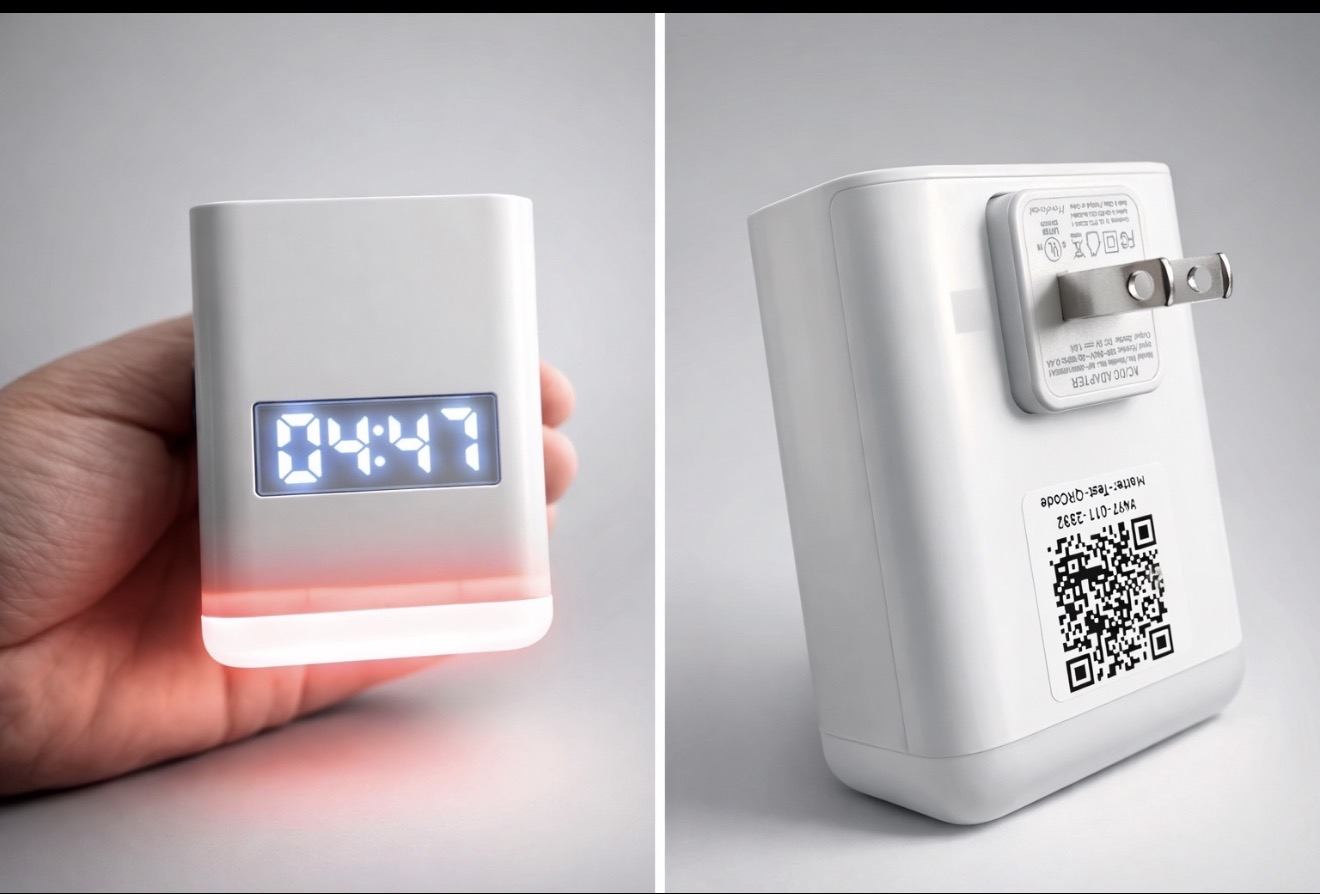
Early AES prototype. The signal direction is green, yellow, and red — always paired with words. Prototype photo — not a finished product.
The Watt-Less clock concept
The original AES concept is an ordinary-looking, plug-in household digital clock with a persistent color cue. A clock is familiar, useful, and likely to stay visible in a home. The signal works through passive awareness — someone notices it in the course of daily life, without seeking out a dashboard or responding to repeated notifications.
Concept in development — a product and prototype direction, not a commercially available device. No specifications, launch dates, purchasing options, or finished integrations are claimed here.
AES is proposed as a behavioral demand-response layer: a simple cue to help households shift flexible electricity use away from expensive peak periods. The hypothesis is that a persistent, passive signal could work without sustained app engagement.
Success judged by demand shifted, not by clicks or app engagement.
Proposed pilot scope
Prior planning considered roughly 1,200 high-peak residential customers, comparison with historical usage, weather normalization, and aggregate or anonymized reporting. These are proposals, not completed Watt-Less results.
About / current stage
Watt-Less is the product idea; the Advanced Energy Signal (AES) is its signaling concept. Specific features, rate integrations, and availability will be confirmed later. Nothing on this page is a purchase offer or a guarantee of savings.
What this is, and isn't